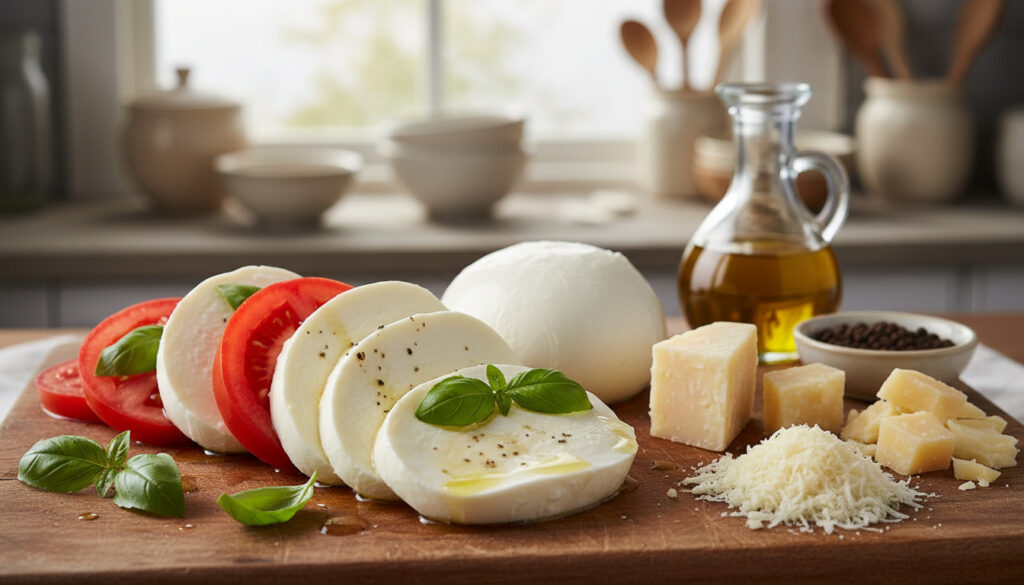
Mozzarella – Jak Wybrać i Wykorzystać w Kuchni
Introduction
Mozzarella carries the weight of Campanian tradition in every pearl of milk. Unlike aged cheeses that improve over months, this pasta filata variety begins deteriorating the moment it leaves the vat, creating a logistical paradox: the finest specimens rarely travel far from their origin. What reaches supermarket shelves often represents a compromise between authenticity and shelf stability, yet understanding the production mechanics reveals why fresh mozzarella commands reverence among chefs.
Defining Characteristics
The category encompasses distinct products unified by technique rather than ingredients:
- Milk Provenance: Water buffalo produce the archetypal Mozzarella di Bufala Campana DOP, while cow’s milk yields Fior di Latte. bufala contains roughly twice the fat content of standard cow’s milk, contributing to its richer mouthfeel.
- Moisture Thresholds: Fresh varieties retain 52-60% water, creating the characteristic weaping texture where droplets form on cut surfaces.
- Consumption Window: Optimal flavor develops within 48 hours of production, after which enzymatic activity degrades the delicate structure.
- Thermal Sensitivity: The protein matrix collapses irreversibly when frozen, making fresh mozzarella unsuitable for long-term storage.
Production Insights
The chemistry of mozzarella production distinguishes it from other fresh cheeses. During the pasta filata stage, calcium phosphate dissolves from casein micelles when curd meets 80°C water. This molecular rearrangement creates unique stretchability, aligning protein fibers parallel to the string. The result maintains structural integrity when melted, unlike aged varieties that separate into distinct fat and protein layers.
For further exploration of Italian dairy traditions, see our guide to premium cheese varieties.
Variety Comparison
| Type | Milk Source | Moisture Content | Optimal Application |
|---|---|---|---|
| Mozzarella di Bufala | Water Buffalo | 60% | Raw consumption, Caprese salad |
| Fior di Latte | Cow | 52% | Baking, melting applications |
| Low-Moisture Part-Skim | Cow | 45-48% | Pizza shredding, commercial use |
| Burrata | Cow or Buffalo | Variable | Fresh service, appetizer plates |
Technical Details
Authentic production begins with thermophilic culture addition to raw or pasteurized milk, followed by rennet coagulation. After cutting into curds, the mass rests in whey until reaching optimal acidity—typically pH 5.2-5.4. Workers then transfer the curd to hot water baths where manual stretching occurs. The nutritional profile reflects this minimal processing, retaining high moisture and lower sodium than aged alternatives.
Industrial producers utilize citric acid acceleration, reducing fermentation from four hours to 45 minutes. While this increases throughput, it compromises the development of complex flavor compounds. The stretched curd is then formed into balls—mozzare referring to the cutting off of individual portions—ranging from bite-sized bocconcini to large zizzona braids.
Historical Timeline
Monastic records from 12th-century Campania document the earliest production, though the cheese likely predates written accounts. By 1570, the term appeared in Italian court documents, derived from mozzare (to cut off). The 20th century brought industrialization and refrigeration, yet 1996 marked the EU granting DOP status to Mozzarella di Bufala Campana, legally protecting traditional methods within specific provinces including Caserta and Salerno. Global production now exceeds one million tons annually, though FAO statistics indicate less than 10% meets traditional standards.
Clarity on Common Myths
Vacuum-sealed products labeled “fresh” bear little resemblance to traditional specimens. Modified atmosphere packaging extends shelf life to 30 days but alters texture significantly, creating a rubbery consistency absent in true fresh cheese. Freezing remains the most destructive practice—ice crystal formation ruptures protein networks, rendering the thawed product mealy and tasteless.
Additionally, the liquid surrounding packaged mozzarella is typically brine or whey solution with 1-2% salt, maintaining hydration and preventing bacterial growth. This should not be discarded before serving, as the cheese continues to require moisture maintenance.
Market Analysis
Pricing differentials reflect biological constraints rather than marketing alone. Water buffalo yield approximately five liters daily compared to thirty liters from dairy cows, with higher solids content (18% versus 12%). The Consortium for Mozzarella di Bufala Campana maintains strict geographic and procedural guidelines, limiting true DOP production to approximately 35,000 tons annually. This scarcity drives premium pricing, particularly in export markets where transportation costs further escalate.
Consumption patterns reveal cultural preferences. Italian markets prioritize same-day consumption, while American markets favor low-moisture variants optimized for pizza logistics. Recent trends show growing demand for burrata—mozzarella shells filled with stracciatella and cream—representing the category’s evolution toward luxury positioning. Jeśli chcesz dowiedzieć się więcej o tym, jak tradycja mozzarelli wpływa na jej wykorzystanie w kuchni, sprawdź darmowy tłumacz polsko rosyjski.
Expert Perspectives
The curd must resist your fingers, then surrender. When you tear it, you should see parallel fibers running the length of the break, not crumbling grains. If it tears immediately, the temperature was wrong during stretching.
— Marco Vitale, Third-generation producer, Paestum
Veteran cheesemakers emphasize that proper storage requires maintaining the cheese in its liquid at 4-8°C, never in airtight containers which promote anaerobic bacterial growth.
Summary
Mozzarella’s identity resists industrialization more than most cheeses. The interplay between milk chemistry, immediate consumption requirements, and hand-stretching techniques creates a product where freshness equals quality. Understanding the distinction between industrial and artisanal production clarifies why authentic specimens command premium prices, while recognizing the legitimate applications of low-moisture variants for specific culinary needs.
Frequently Asked Questions
Can you freeze fresh mozzarella for later use?
Freezing ruptures the delicate protein membranes and destroys the characteristic texture. Upon thawing, the cheese becomes mealy and rubbery, losing its signature moisture release. For preservation, consume within 48 hours of purchase or maintain in refrigerated brine.
Why does buffalo mozzarella cost significantly more than cow’s milk versions?
Water buffalo produce lower milk volumes with higher butterfat and protein content. A buffalo yields approximately five liters daily versus thirty liters from dairy cows, requiring significantly more animals to produce equivalent cheese volumes. Additionally, DOP regulations mandate specific geographic and procedural requirements that limit mass production.
What causes the liquid inside mozzarella packaging?
The liquid is typically brine or whey solution containing 1-2% salt. This maintains hydration, prevents bacterial growth, and preserves the cheese’s soft texture. The liquid should not be discarded completely before serving; rather, store the cheese submerged in this solution until consumption.
How can consumers identify authentic Mozzarella di Bufala Campana?
Authentic DOP products bear a numbered seal from the Consortium and specify production in Campania, Lazio, Puglia, or Molise regions. The cheese should display a porcelain-white color, spherical shape, and slightly elastic consistency. Packaging should indicate “Mozzarella di Bufala Campana DOP” specifically, not merely “buffalo mozzarella.”
Wiecej powiazanych wpisow
 PSG – Zawodnicy 2025/2026: Skład, Kontuzje, Legendy i Transfery
 Komputer stacjonarny 2026 – poradnik i ranking
 Kwas askorbinowy – właściwości, dawkowanie, acerola
 French Open 2024: odpowiedzi na najczęściej zadawane pytania
 Seat Ibiza 3 – opinie, silniki, dane techniczne, czy warto kupić
 Cloud Mail – Kompletny Przewodnik po Poczcie Chmurowej
 Adderall – działanie, skutki uboczne i porównanie z Ritalinem
 ERLI klep – co to je t, opinie, jak działa? [Przewodnik 2025]
